[email protected] Onsite-Verified by SGS Group Xi'an, Shaanxi, China
EnglishEnglish
0%

Choosing among China’s Apple Cider Vinegar Powder suppliers requires more than comparing prices. A reliable supplier should show practical manufacturing experience, stable production capacity, and clear quality documentation. Buyers need to examine the powder’s acetic acid content, moisture level, carrier ingredients, solubility, flavor, and shelf life. Small details matter. A sharp acidic smell may signal poor processing or unsuitable storage.

Professor Carol S. Johnston, a respected vinegar researcher, has cautioned, “Vinegar is not a magic bullet.” That reminder supports a careful, evidence-based approach to Apple Cider Vinegar Powder. The ingredient may suit beverage mixes, gummies, capsules, seasonings, and functional food formulas. However, its performance depends on concentration, processing conditions, and the final application. Supplier claims should never replace laboratory verification.

This guide examines leading China-based suppliers through a practical purchasing lens. It considers GMP, HACCP, ISO certification, batch testing, traceability, and export experience. A trustworthy company should provide a recent Certificate of Analysis, microbiological results, heavy-metal testing, and allergen information. Product samples should also be tested in the buyer’s own formula.

No supplier is flawless. Even an attractive website proves little. Packaging can look impressive while the powder settles unevenly in water. That is why communication, sample consistency, and corrective-action support deserve attention. The strongest supplier is not always the cheapest. It is the one that can explain its process clearly and repeat the same quality batch after batch.
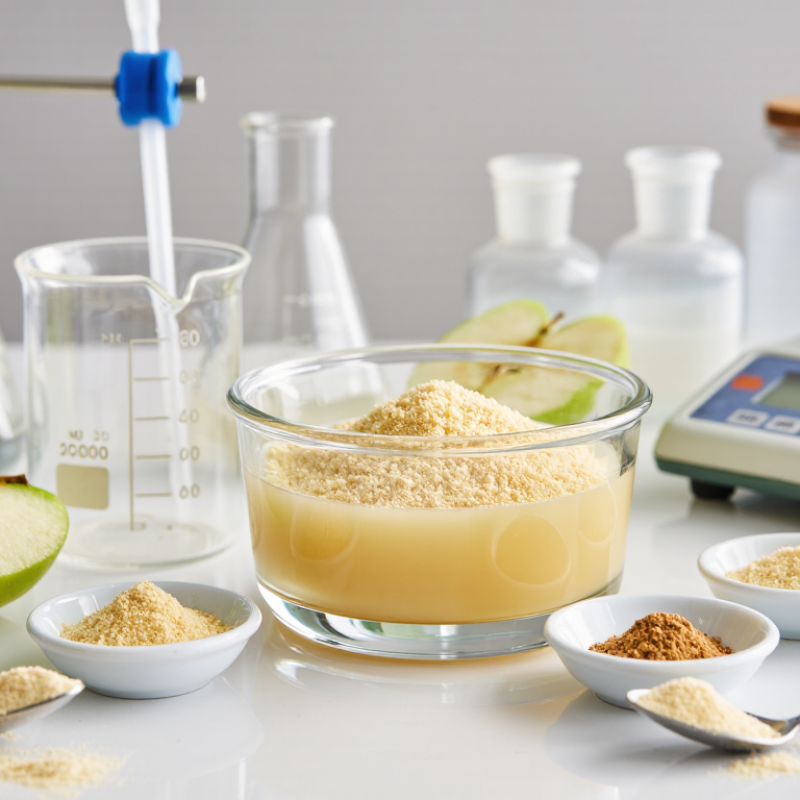
China Top Apple Cider Vinegar Powder Suppliers?

Apple Cider Vinegar Powder: Acidity, Carrier Ratio, Solubility, and pH Data

China Top Apple Cider Vinegar Powder Suppliers?

Apple cider vinegar powder needs more than a strong vinegar aroma. The key figure is acidity, usually reported as acetic acid equivalent. Codex CXS 162-1987 sets 4% acidity as a benchmark for vinegar products, but powder specifications vary after drying.

Buyers should request titratable acidity results using AOAC 942.15 or an equivalent validated method. Do not confuse acidity with pH. They measure different properties.

Carrier ratio changes the powder’s behavior. A 1:1 ratio may deliver stronger flavor, while a 1:4 or 1:5 ratio often improves flow and reduces stickiness. The exact ratio should appear on the specification sheet.

Solubility testing also matters. In a practical check, 10 grams of powder can be stirred into 100 milliliters of room-temperature water. Record wet lumps, sediment, and mixing time.

A clear solution is useful, but slight haze is not automatically a defect.

pH should be tested after a defined dilution, such as a 1% solution. USP General Chapter <791> supports standardized pH measurement, yet the powder itself has no single universal pH value.

Moisture, carrier type, and organic acids can shift results. Industry ingredient reports often emphasize standardization, but supplier data still needs verification.

One overlooked issue is testing temperature. A result at 25°C may not match one taken in a warm warehouse. That detail deserves attention.

China’s Supplier Market: MOQ, OEM Capacity, Export Volume, and Lead-Time Metrics

China’s apple cider vinegar powder market is fragmented, and supplier metrics need careful verification. UN Comtrade’s 2023 HS 220900 data places China among major vinegar exporters, but it does not isolate powdered products. Powder may appear under broader food-preparation codes. This weakens export-volume comparisons.

Typical factory quotations indicate MOQs of 100–500 kilograms for standard powder. Customized flavors, carriers, or private packaging can raise the MOQ to 1,000 kilograms or more. OEM capability usually includes pouch filling, drum packing, moisture control, and bilingual labels. Some facilities offer spray drying, while others outsource it. That difference matters.

Lead times commonly range from 15–30 days for stocked material and 30–60 days for new OEM orders. Complex testing can extend the schedule. The International Trade Centre recommends checking product classification, certificates, and shipment history before comparing suppliers. China Customs records can support that review, but export data rarely confirms the exact powder grade.

A practical audit should request batch records, water activity, mesh size, carrier percentage, and recent laboratory results. Ask for a pilot sample. Small errors become expensive later. Supplier responses are not always consistent, especially for “natural” acidity and active-content claims. I would treat any unusually low MOQ or seven-day lead time as a question, not an advantage.

Ranking Top Suppliers by COA Results, 5% Acetic Acid, and Purity Standards

China’s leading apple cider vinegar powder suppliers should be ranked by evidence, not attractive catalogs. A reliable comparison begins with recent batch-specific COAs. Each COA should show the lot number, test date, laboratory method, and product identity. Generic certificates raise questions.

The 5% acetic acid specification deserves close attention. A strong supplier reports the measured result, acceptable tolerance, and testing method. Results near the target can indicate better process control than vague claims such as “high strength.” Purity testing should also cover moisture, ash, residual solvents, heavy metals, pesticides, and microbiological limits. HPLC or validated titration data can support the acetic acid result, but the method must be clearly stated.

I would rank suppliers higher when documents match physical samples and packaging labels. A sealed sample should have consistent color, fine flow, and no sharp fermented odor beyond expectation. Third-party laboratory verification adds credibility, especially for larger purchases. Still, one sample cannot prove every shipment. That is the uncomfortable part. Supplier performance can change with harvest material, drying conditions, or subcontracted processing. Buyers should request multiple recent COAs and compare results across lots. A careful audit may reveal missing signatures, inconsistent units, or unexplained purity figures. Those details matter more than polished marketing language.

China Top Apple Cider Vinegar Powder Suppliers? — COA-Based Quality Benchmark

This supplier-neutral benchmark compares the main quality dimensions used when reviewing apple cider vinegar powder COAs. A 5.0% acetic-acid declaration is treated as the reference target; actual supplier rankings should be confirmed against current, lot-specific COAs and independent laboratory reports.

How to read the chart: The scores represent the relative importance of each verification dimension in a practical purchasing review. Acetic-acid confirmation, identity/purity testing, and microbiological and contaminant controls should be checked before comparing suppliers.

Production Compliance: HACCP, ISO 22000, GMP, and Heavy-Metal Testing

When evaluating China’s top apple cider vinegar powder suppliers, production compliance deserves more attention than price. A reliable facility should map hazards from apple receiving through concentration, spray drying, packing, and storage. HACCP records should identify control points, such as heating temperatures, moisture levels, and foreign-material checks. Ask for monitoring limits, corrective actions, and dated verification records. Paperwork alone is not enough. During a supplier audit, inspect cleaning schedules, employee hygiene controls, pest prevention, and equipment calibration. GMP should be visible on the factory floor, not only in a certificate folder.

ISO 22000 certification can show a structured food-safety management system, but certificate scope matters. Confirm it covers the actual powder facility and current production activities. Heavy-metal testing requires equal care. Request recent, batch-specific results for lead, arsenic, cadmium, and mercury from an independent laboratory. Review test methods, detection limits, sample identity, and laboratory accreditation. A complete certificate of analysis should also list acidity, moisture, microbiological results, and carrier ingredients. Traceability should connect one finished bag to raw-material lots, operators, dates, and release approval. Auditors sometimes find attractive documentation hiding weak sampling practices. That risk deserves honest questioning. Suppliers may maintain strong systems, yet occasional gaps can appear during busy production periods. Look for transparent answers, not perfect claims.

China Top Apple Cider Vinegar Powder Suppliers? - Production Compliance: HACCP, ISO 22000, GMP, and Heavy-Metal Testing
Compliance Dimension What a Qualified Supplier Should Demonstrate Typical Evidence to Request Why It Matters for Apple Cider Vinegar Powder Assessment
HACCP Food-Safety System Documented hazard analysis covering raw materials, fermentation, concentration, drying, blending, metal detection, packaging, and storage. Current HACCP plan, process-flow diagram, hazard analysis, critical-control-point records, corrective-action logs, and verification records. Helps control biological, chemical, and physical hazards introduced during fermentation, powder processing, and final packing. Strongly Recommended
ISO 22000 / FSSC 22000 A certified food-safety management system with defined prerequisite programs, traceability, internal audits, management review, and continual improvement. Valid certificate, certification scope, audit date, certificate number, issuing certification body, and site address. Provides a structured framework for managing food-safety risks across the complete supply chain and production site. Strongly Recommended
GMP Controls Controlled hygiene, personnel practices, sanitation, pest management, equipment maintenance, allergen controls, and documented manufacturing procedures. GMP certificate or audit report, sanitation records, environmental-monitoring records, employee-training logs, and pest-control reports. Reduces the likelihood of contamination, mix-ups, foreign materials, and inconsistent batch quality. Strongly Recommended
Raw-Material Traceability Ability to trace vinegar or apple-derived inputs from approved source through processing, blending, packaging, and shipment. Supplier-approval procedure, incoming inspection records, batch codes, lot genealogy, and one-step-back/one-step-forward traceability tests. Supports rapid investigation and recall management if a raw-material or finished-product issue occurs. Required for Reliable Supply
Product Specification Defined requirements for appearance, odor, moisture, pH or acidity where applicable, carrier content, particle size, solubility, and microbiological limits. Approved product specification, manufacturing standard, packaging specification, and documented change-control procedure. Ensures the powder performs consistently in beverages, supplements, premixes, and other formulations. Required for Commercial Supply
Microbiological Testing Routine testing appropriate to the product and intended use, commonly including total plate count, yeast and mold, coliforms, and relevant pathogens. Lot-specific certificate of analysis, test methods, laboratory accreditation information, sampling plan, and corrective-action records. Verifies that drying, handling, and packaging have not resulted in unacceptable microbial contamination. Required for Each Qualified Lot
Heavy-Metal Testing Risk-based testing for lead, arsenic, cadmium, and mercury, with limits selected according to the destination market and product category. Independent laboratory report, test method, detection limits, sample identity, test date, and lot number matching the shipment. Metals may originate from agricultural inputs, water, processing equipment, packaging, or environmental contamination. Limits vary by jurisdiction and intended use. Required for Market Access
Pesticide-Residue Control Risk-based screening appropriate to the apple-derived raw materials and the regulatory requirements of the importing country. Multi-residue pesticide report, approved raw-material list, supplier declarations, and agricultural sourcing controls. Helps verify that raw materials comply with applicable maximum residue limits and customer requirements. Market-Dependent
Residual Solvent and Chemical Control Documented confirmation that no prohibited processing chemicals are used and that any applicable residues are controlled within legal limits. Process description, chemical-use register, supplier declarations, and targeted laboratory testing when the process presents a relevant risk. Supports regulatory compliance and reduces the risk of undeclared or unintended chemical residues. Process-Dependent
Foreign-Material Prevention Controls such as sieving, magnets, metal detection, equipment inspection, glass-and-brittle-plastic procedures, and documented line clearance. Metal-detector challenge records, sieve-integrity checks, preventive-maintenance logs, and foreign-material incident reports. Powder handling can create risks from metal fragments, damaged screens, packaging materials, or equipment wear. Required for Reliable Production
Moisture and Water Activity Defined moisture and, where relevant, water-activity targets supported by validated or routinely verified test methods. Batch test results, instrument-calibration records, drying-process parameters, and storage-stability data. Proper control helps limit caking, microbial growth, oxidation, and loss of powder flowability during storage. Strongly Recommended
Stability and Shelf Life Documented shelf-life rationale based on real-time or accelerated stability data under defined packaging and storage conditions. Stability protocol, time-point results, packaging configuration, recommended storage conditions, and expiry-date policy. Confirms that acidity, flavor, color, moisture, and microbiological quality remain acceptable through the stated shelf life. Strongly Recommended
Packaging and Label Controls Food-contact packaging, lot coding, net-weight checks, tamper-evidence controls where applicable, and label review against destination-market rules. Packaging specification, food-contact declaration, label approval record, artwork-control procedure, and packaging inspection records. Protects the powder from moisture and contamination while supporting traceability and correct regulatory labeling. Required for Commercial Supply
Laboratory Competence Testing performed by a competent in-house laboratory or an appropriately accredited independent laboratory using validated methods. Laboratory accreditation scope, method references, calibration records, proficiency-testing evidence, and signed analytical reports. Improves confidence that certificates of analysis and contaminant results are accurate, reproducible, and traceable. Strongly Recommended
Batch Release and CAPA Formal review and release of each batch, with documented handling of deviations, complaints, nonconforming products, and corrective/preventive actions. Batch-release checklist, deviation reports, complaint log, CAPA records, recall procedure, and mock-recall results. Demonstrates that the supplier can identify problems, prevent recurrence, and protect customers from nonconforming product. Required for Reliable Supply
Regulatory and Export Documentation Documentation aligned with the importing country, product classification, intended use, and customer-specific requirements. Certificate of analysis, specification sheet, safety data information where applicable, certificate of origin, health documentation, and export records. Reduces customs delays and helps confirm that the product can be legally marketed in the target destination. Destination-Dependent
Supplier Audit Readiness Willingness to support document review, remote or on-site audits, sample approval, production-trial review, and periodic requalification. Audit questionnaire, recent audit findings, action-plan closure evidence, sample-retention procedure, and requalification schedule. Allows buyers to verify that certificates and laboratory documents reflect actual operating controls at the production site. Strongly Recommended

Supplier Evaluation: Price per Kilogram, Sample Testing, Packaging, and Delivery Terms

China Top Apple Cider Vinegar Powder Suppliers?

Price per kilogram should never stand alone. A low quotation may exclude carrier materials, testing, or export preparation. Compare equivalent specifications, including acidity, moisture, carrier percentage, mesh size, and minimum order quantity. Grand View Research valued the global vinegar market at approximately USD 1.3 billion in 2023, showing strong commercial demand but not guaranteeing powder quality. Request a recent quotation with an Incoterm and a complete cost breakdown. Small details matter.

Sample testing is essential. Ask for 200–500 grams from the actual production lot, not a specially prepared sample. Check color, flowability, odor, solubility, acidity, moisture, and microbiological results. ISO 22000-based systems emphasize documented food-safety controls, while Codex guidance supports risk-based verification. An independent laboratory can test identity and contaminants. This costs more, but a failed production batch costs far more. I would still question every certificate. Paperwork can look convincing.

Packaging should protect the powder from moisture and caking. A sealed inner liner inside a fiber drum or food-grade carton is practical for bulk orders. Confirm net weight, lot number, production date, shelf life, and storage temperature. Delivery terms need equal attention. Request lead time, sample dispatch time, loading port, carton dimensions, and replacement rules for damaged goods. The 2024 UNCTAD Review of Maritime Transport highlights continuing volatility in shipping conditions. Therefore, avoid promises based only on a standard seven-day estimate. Allow inspection time before final payment.

FAQS

What is a typical minimum order quantity for apple cider vinegar powder?

Standard powder often starts at 100–500 kilograms. Customized flavors, carriers, or packaging may require 1,000 kilograms or more. Confirm the MOQ in writing.

What OEM services are commonly available?

Facilities may provide pouch filling, drum packing, moisture control, and bilingual labels. Some handle spray drying internally. Others outsource it. Ask who controls each step.

How long do orders usually take?

Stocked materials commonly require 15–30 days. New customized orders may take 30–60 days. Complex testing can extend the schedule. Seven days deserves questions.

Can export data prove the exact powder volume?

Usually not. Broad customs categories may combine liquid vinegar and other food preparations. Export totals can suggest market activity, but they may mislead.

What should a batch-specific COA include?

It should show the lot number, test date, laboratory method, and product identity. Generic certificates are weaker evidence. Missing signatures deserve review.

How should a 5% acetic acid claim be checked?

Request the measured result, tolerance range, and testing method. Validated titration or HPLC data may support the result. “High strength” is not precise enough.

Which purity tests should buyers request?

Check moisture, ash, residual solvents, heavy metals, pesticides, and microbiological limits. Also review water activity, mesh size, and carrier percentage. Small omissions matter.

Why is a pilot sample important?

A sealed sample can reveal color, flow, odor, and label consistency. Compare it with recent COAs. One sample cannot prove every shipment. That remains uncomfortable.

How can suppliers be compared fairly?

Compare several recent lots, not one polished certificate. Match documents with physical samples and packaging labels. Independent laboratory testing adds confidence for larger orders.

What warning signs require closer verification?

Be cautious with unusually low MOQs, extremely short lead times, vague purity figures, and inconsistent units. Supplier performance can change between batches. Marketing language is not evidence.

Conclusion

This guide explains how to evaluate Apple Cider Vinegar Powder suppliers in China by focusing on the technical and commercial factors that determine product quality and reliability. It covers acidity, acetic acid concentration, carrier ratio, solubility, pH, and purity, while also examining supplier capabilities such as minimum order quantities, OEM flexibility, export experience, production capacity, and lead times. Clear comparison criteria help buyers understand how laboratory data and certificates of analysis can support consistent product selection.

The article also outlines key production compliance requirements, including HACCP, ISO 22000, GMP, and heavy-metal testing. In addition to quality standards, buyers should compare pricing per kilogram, sample-testing procedures, packaging options, delivery terms, and communication efficiency. By reviewing these factors together, importers, distributors, and manufacturers can identify suitable suppliers, reduce quality risks, and establish a dependable purchasing process for Apple Cider Vinegar Powder.

Aveline

Aveline

Aveline is a professional marketing specialist with a deep understanding of the company’s products, customer needs, and industry trends. Through a combination of strategic insight, clear communication, and practical market knowledge, Aveline helps present complex product information in an......